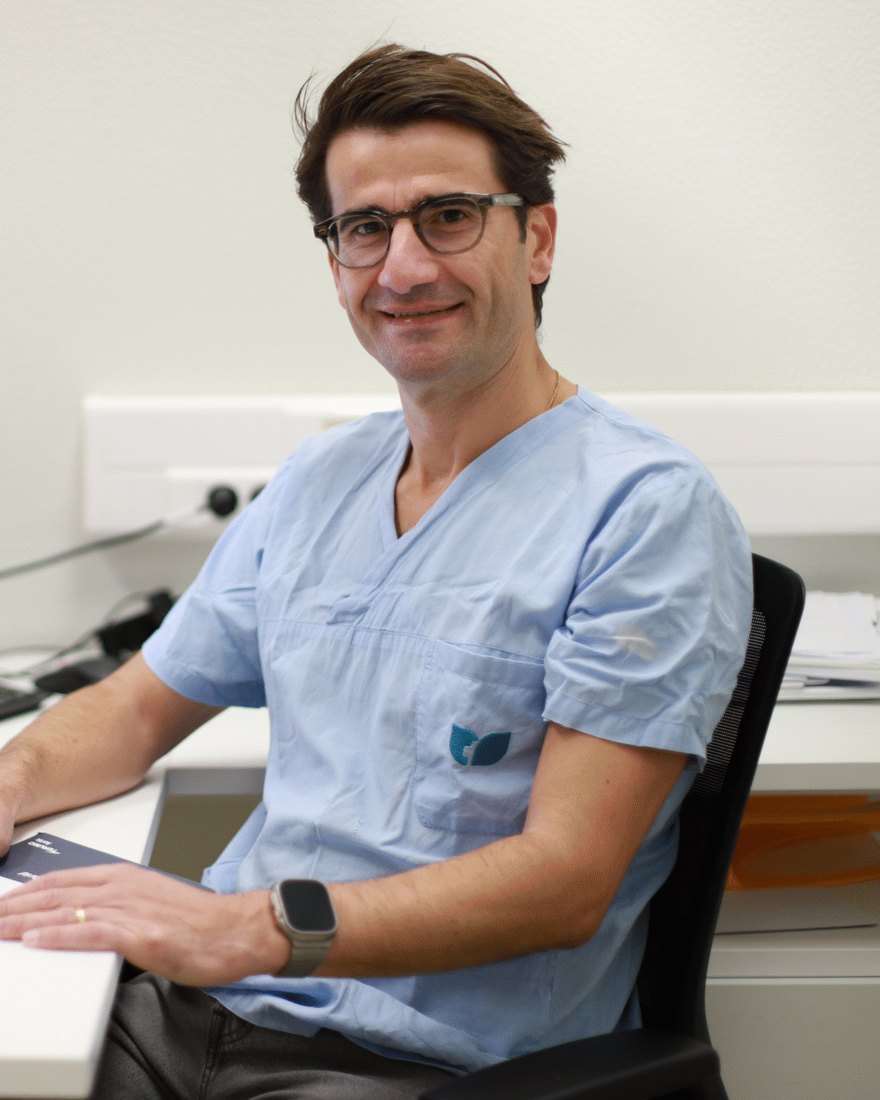
Head of Service · ULS Gaia e Espinho
Cardiothoracic surgeon in Vila Nova de Gaia, Portugal.
Has led the Cardiothoracic Surgery Service at ULS Gaia e Espinho since 2024, with more than 1,500 cardiac operations as main surgeon. Has taken part in the clinical development of several cardiovascular devices, from first-in-human use to routine practice.
Paulo Neves, MD, MSc, MBA, FETCS
Career
Residency, hospital career and service leadership at the same centre in Vila Nova de Gaia.
Clinical research
Has taken part in clinical studies of new cardiovascular devices, from first-in-human use to regulatory approval.
- Clinical development from first-in-human studies through CE marking
- Design and leadership of multicentre trials in Europe, the United States and Asia
- Co-inventor of a new ECMO cannulation strategy, with a patent application filed
The Service in Gaia
Cardiothoracic Surgery Service, ULS Gaia e Espinho
11 surgeons and about 1,500 operations a year. Since 2024 the Service has worked to three priorities: improving access, following shared protocols, and measuring results every month.
Better access to surgery
Access to cardiac surgery has improved.
Shared protocols
Shared protocols from referral to discharge, and fast-track recovery after surgery.
Monthly quality audit
The Service's results are audited internally every month.
Ventricular assist and new techniques
An LVAD and mechanical circulatory support programme, and regular introduction of new surgical techniques.
Areas of clinical expertise
Valve surgery, including minimally invasive approaches, mitral repair, arterial coronary revascularisation and surgery for advanced heart failure.
New technologies introduced
- PTFirst in Portugal to use several new techniques in aortic valve surgery and mitral repair
- WorldFirst user of a new bidirectional arterial cannula, and principal investigator of its clinical study
Information for patients and families
What to expect before and after heart surgery. If anything here differs from what your surgical team told you, follow your team.
Surgical procedures
Coronary bypass surgery
New routes for blood around narrowed coronary arteries, using your own arteries and veins. Arterial grafts are preferred, as they tend to last longer.
Aortic valve surgery
Replacing a narrowed or leaking aortic valve. For many patients this is done through a small incision between the ribs, without opening the breastbone.
Mitral valve repair
Whenever possible, the patient’s own valve is repaired rather than replaced. A repaired valve preserves heart function and usually avoids lifelong anticoagulation.
Aortic surgery
Treatment of aneurysms and dissection of the ascending aorta and arch, including hybrid prostheses that treat the arch and descending aorta in one operation.
Minimally invasive surgery
Smaller incisions and, where possible, no sternotomy: less pain, less bleeding and a quicker return to normal life for suitable patients.
Advanced heart failure
Ventricular assist devices (LVAD) and other mechanical circulatory support, through a dedicated programme at ULS Gaia e Espinho.
Recovery at home
What will change
Caring for the wound
Medicines and pain
Checking your vital signs
Eating well
Anticoagulation
Physical activity
Protecting the breastbone
Watching for complications
This page gives general information and is not medical advice for any individual. Always follow the specific instructions you received when you were discharged.
Teaching and service
Education
Publications
Search PubMedPeer-reviewed articles, newest first.
-
2025Misconnected: valve failure from an unexpected chordal insertionNovo C, Campos M, Neves P, Guerra M. Rev Port Cir Cardiotorac Vasc. 2025;32(4)
-
2021Patient selection for LIVE therapy: from clinical indications to multimodality imaging individual case planningNeves P, Pillay T, Annest L, van Bladel K, Kaiser E, Stahl F, Hanke T, Swaans M, Klein P, Ruf T, von Bardeleben RS. Echocardiography. 2021Read the article
-
2021Transapical off-pump mitral valve repair with NeoChord implantation: an early single-center Portuguese experienceGonçalves-Teixeira P, Costa S, Martins D, Neves P, Ribeiro J. Rev Port Cardiol. 2021;40:933-41Read the article
-
2021LIVE procedure for the treatment of ischemic heart failure: current short and mid-term outcomesNeves P, Pillay T, Annest L, Van Bladel K, Kaiser E, Wechsler A, Klein P, Hanke T, von Bardeleben RS. J Am Coll Cardiol. 2021;77(18 Suppl 1):588
-
2021Minimal access left ventricular reconstructionPillay T, Neves P, Benetti F, Van Bladel K, Wechsler A, Annest L. J Card Surg. 2021;36(1):300-306Read the article
-
2020LIVE procedure for ischemic heart failure: the evolution of a unique techniqueNeves P, Pillay T, Van Bladel K, Annest L. Eur Heart J. 2020;41(Suppl 2)
-
2020Thrombocytopenia after Perceval prosthesis implantation: still a mysteryNeves P. Rev Port Cir Cardiotorac Vasc. 2020;27(2):77
-
2020Total aortic arch replacement with E-vita OPEN PLUS hybrid prosthesis: initial experience from a single surgical centerLareiro N, Vieira M, Panzina A, Millner T, Lareiro S, Neves P, Ponce P, Vouga L. Rev Port Cir Cardiotorac Vasc. 2020;27(1):17-22
-
2020Total arch replacement with hybrid prosthesis: the best solution for a complex problemNeves P. Rev Port Cir Cardiotorac Vasc. 2020;27(1):11
-
2019Rapid deployment prosthesis: a powerful tool to be used wiselyNeves P. Rev Port Cir Cardiotorac Vasc. 2019;26(3):179-180
-
2019Predictors of acute kidney injury associated with cardiopulmonary bypassMoreira R, Jacinto T, Neves P, Vouga L, Baeta C. Rev Port Cir Cardiotorac Vasc. 2019;26(2):109-115
-
2019Post cardiopulmonary bypass renal failure: do we need goal directed perfusion?Neves P. Rev Port Cir Cardiotorac Vasc. 2019;26(2):91-92Read the article
-
2019Correction of adult-type VSD causing aortic valve endocarditis through aortotomyMonteiro JP, Rijo D, Simões Costa S, Pereira R, Vieira M, Ponce P, Vouga L, Neves P. Rev Port Cir Cardiotorac Vasc. 2019;26(1):55-58
-
2018Minimally invasive aortic coarctation correction and aortic valve replacement without sternotomyNeves P, Ponce P, Braga P, Vouga L. Rev Port Cir Cardiotorac Vasc. 2018;25(3-4):127-129
-
2017Aortic valve replacement with Perceval bioprosthesis: initial single-center experienceRijo D, Simões Costa S, Monteiro JP, Neves F, Vouga L, Neves P, Ponce P, Guerra M. Rev Port Cir Cardiotorac Vasc. 2017;24(3-4):123
-
2017Predictors of acute kidney injury in the postoperative period of cardiac surgery associated with cardiopulmonary bypassMoreira R, Jacinto T, Neves P, Vouga L, Baeta C. Rev Port Cir Cardiotorac Vasc. 2017;24(3-4):154
-
2016Surgical treatment of type A acute aortic syndrome: is there a paradigm change?Neves P. Rev Port Cir Cardiotorac Vasc. 2016;23(3-4):191-193
-
2016Right anterior minithoracotomy aortic valve replacement: how we do itNeves P, Monteiro JP, Ponce P, Vouga L. Rev Port Cir Cardiotorac Vasc. 2016;23(3-4):177-181
-
2014Transapical aortic valve and mitral valve-in-ring prosthesis implantation: a new advance in transcatheter proceduresNeves PC, Paulo NS, Gama V, Vouga L. Interact Cardiovasc Thorac Surg. 2014
-
2014Simultaneous transapical implantation of an inverted transcatheter aortic valve-in-ring in the mitral position and transcatheter aortic valve replacement: first-in-human reportLadeiras-Lopes R, Vouga L, Braga P, Paulo N, Azevedo AI, Neves P, Ribeiro J, Fonseca M, Gama V. J Am Coll Cardiol. 2014;63(12):e25
-
2014Papillary fibroelastoma of the pulmonary valveFonseca P, Neves P, Ribeiro J, Gonçalves H, Couceiro A, Gama V. Rev Port Cardiol. 2014;33(1):57-8
-
2013Surgical treatment of non-small-cell lung cancer in octogenariansGuerra M, Neves P, Miranda J. Interact Cardiovasc Thorac Surg. 2013;16(5):673-80
-
2013Pulmonary artery sarcoma: a rare cause of syncopeNeves P, Guerra M, Mâncio J, Ponce P, Vouga L. Rev Port Cir Cardiotorac Vasc. 2013;20(1):19-21
-
2012Surgical treatment of non-small cell lung cancer in octogenarians: safety and prognosisNeves PC, Guerra M, Martins D, Ponce P, Miranda J, Vouga L. Rev Port Cir Cardiotorac Vasc. 2012;19(2):63-67
-
2012Surgery for thoracic empyema: personal experience and current highlightsGuerra M, Neves PC, Martins D, Miranda J, Leal F, Vouga L. Rev Port Cir Cardiotorac Vasc. 2012;19(1):21-6
-
2011Non-cystic fibrosis bronchiectasisNeves PC, Guerra M, Ponce P, Miranda J, Vouga L. Interact Cardiovasc Thorac Surg. 2011
-
2011Principais complicações do tratamento cirúrgico do cancro do pulmãoNeves PC, Miranda JA, Guerra M. Rev Port Cir Cardiotorac Vasc. 2011;18(4):215-220
-
2011Simpaticectomia toracoscópica para o tratamento da hiperhidroseGuerra M, Neves PC. Rev Port Cir Cardiotorac Vasc. 2011;18(2):77-84
-
2010Large atrial myxomaNeves PC, Guerra M, Mateus C, Ponce P, Cascarejo J. Rev Port Cir Cardiotorac Vasc. 2010;17(4):265-266
Contact
For patient referrals, clinical collaboration, scientific meetings and advisory work. Patients may also contact the Cardiothoracic Surgery Service of ULS Gaia e Espinho directly.